

Want to be the first to hear latest news and find out about our exclusive promotions.
Sign Up for Our Newsletter:
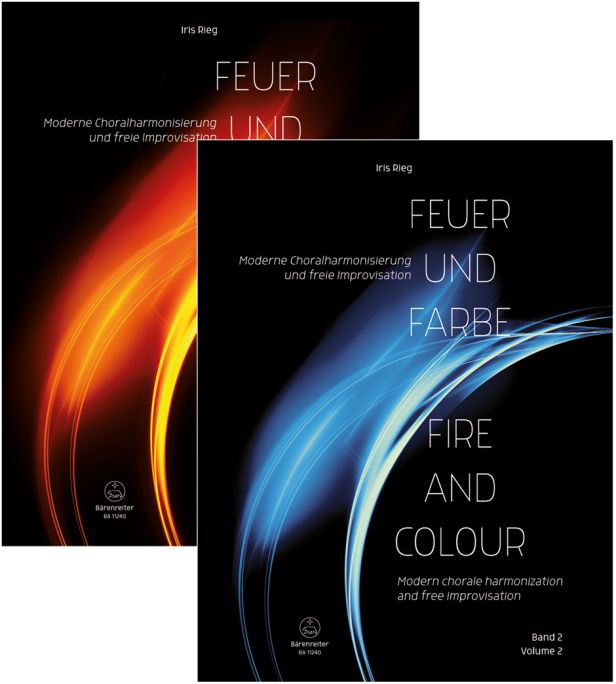
Fire and Colour: Modern chorale harmonisation and free improvisation for organ
Rieg, Iris
Rieg Fire and Colour: Modern chorale harmonisation and free improvisation for organ
In her two-volume organ improvisation method, Iris Rieg presents an immense wealth of creative yet systematic approaches for discovering colourful harmonies on the “queen of instruments.” She clearly demonstrates how one can experiment and play with intervals, chords, scales, rhythm patterns and much more, in styles ranging from the Renaissance to the modern era.
In the first volume, the author provides an introduction to various harmonic techniques, starting with systematic exercises based on parallel shifting musical structures (intervals, chords). The harmonisation of scales leads to interesting chord combinations, including those based on thirds and tritones. Using ostinato models, instructions are given for the conception of a virtuoso toccata.
Significant milestones in the history of organ music form the guiding principle for the second volume. Here organists becomes acquainted with characteristic improvisation techniques. Valuable tips for creating stylistic imitations enrich the detailed descriptions of multi-movement forms, such as concerto, mass or suite. Particular emphasis is based on romantic harmonisation (Max Reger) and French tonal aesthetics (Marcel Dupré).
The two volumes, which are ideal for self-study for students, teachers and professional organists, are aimed at those who want to start improvising in church services, but also offer inspiration to those who already improvise on a daily basis and, for example, want to create an organ symphony based on hymns in a live setting. The numerous exercises at different levels of difficulty are logically structured yet allow organists to start at any chapter and begin right away.
Above all, the joy of playing always takes centre stage!
About the author:
Iris Rieg is a freelance concert organist, lecturer, author and church musician. She graduated from the music academies in Stuttgart, Detmold and Paris and now teaches at the University of Cologne and at the music school of the Cologne Cathedral Choir as well as running a busy private teaching practice.
- Edition with text in German and English
- Methodical presentation of large-scale organ music in a broad range of styles
- Uncluttered modern layout with many music examples
Contents
- Volume 1: Foreword
- Introduction
- I Parallel Chord Shifts and Their Uses
- 1. Parallel thirds
- 2. Parallel fourths and fifths
- 3. Parallel thirds and fifths combined
- 4. Parallel fourths and fifths combined
- 5. Parallel fifths
- 6. Shifts of root-position chords
- 7. Sixte ajoutée – added sixth chords
- 8. Parallel root-position chords with added sevenths
- 9. Parallel first-inversion chords and fauxbourdon
- 10. Parallel first-inversion minor chords with minor seconds
- 11. Parallel second-inversion major chords
- 12. Parallel second-inversion major chords with major seconds
- 13. Parallel second-inversion minor chords with major seconds
- 14. Parallel second-inversion minor chords with minor thirds
- 15. Parallel dominant seventh chords
- 16. Parallel second-inversion dominant seventh chords
- 17. Parallel third-inversion dominant seventh chords
- 18. Parallel dominant seventh chords with fifths
- 19. Parallel dominant seventh chords with sixths
- 20. Parallel major seventh chords
- 21. Parallel minor seventh chords
- 22. Dominant seventh chords in sequences of descending fifths with ninths and elevenths
- 23. Interlude: The influence of jazz harmonies on hymns
- II Scales
- 1. Eighteen different scales on D
- 2. Chromaticism and note repetition
- 3. Modes and chords
- III Further Methods of Harmonic Intensification
- 1. Changing the middle voices in harmonic progression
- 2. Changing the outer voices in harmonic progression
- 3. Triads without notes in common
- 4. Harmonization with the minor dominant
- 5. Third and mediant relationships
- 6. Tritone relationships – the qualities of the diabolus in musica
- 7. Interlude: The diminished chord and its resolution in hymns
- 8. The augmented chord
- 9. Whole tone steps
- 10. Perpetuum mobile
- 11. Chordal timbre – there’s dissonance and dissonance
- IV Bitonality
- 1. Simultaneous use of major and minor modes
- 2. Taking the rules of voice-leading with dissonance into account
- 3. Enharmonics and modulation
- V Rhythm
- 1. Uneven bars
- 2. Phrasing four against five
- 3. Phrasing fiv e against four
- 4. Ostinato, patterns and changes of time signature
- VI Techniques for Fantasias and Toccatas
- 1. Slow introduction or interlude
- 2. Figures in the left hand
- 3. Passagework and embellishment
- 4. Figures in the right hand
- 5. Cantus firmus in the alto part
- 6. Study in velocity on the manuals
- 7. Passagework in both hands
- 8. Swapping functions between hands and cantus firmus in the bass part
- 9. Changes in the position and inversion of chords
- 10. Study in velocity on the pedals
- 11. Sustained and tied notes, final chords
- VII Finale
- 1. Index of hymns
- 2. Recommended music
- 3. Recommended books
- 4. Afterword
- 5. Acknowledgements
- 6. List of rights holders
- Volume 2: Notes
- I Renaissance
- 1. Stylistic techniques of the Renaissance
- 2. Mode and church key
- 3. Cadences II, ornamentation and compositional technique in selected literature
- 4. Renaissance or Early Baroque Suite
- II The Baroque Concerto
- 1. Baroque Concerto 1 st movement: fast
- 2. Baroque Concerto 2 nd movement: slow
- 3. Baroque Concerto 3 rd movement: fast
- III The classical French Baroque Mass
- 1. Chorale en taille
- 2. Duo
- 3. Trio en dialogue
- 4. Dialogue sur les Grands Jeux
- 5. Fugue
- 6. Dialogue sur la Trompette et Cromorne
- 7. Tierce en taille
- IV The French modern suite based on a hymn
- 1. Suite française moderne: 1 st movement
- 2. Suite française moderne: 2 nd movement
- 3. Suite française moderne: 3 rd movement
- 4. Suite française moderne: 4 th movement
- V Romantic Harmonization
- 1. Romantic chords I
- 2. Sequences
- 3. Romantic chords II: chromatic divergence of doubled chord tones
- 4. Successively more progressive harmonization based on a hymn line
- 5. Romantic chords III: repeated notes and chromatic bass lines
- 6. Romantic chords IV: suspended notes and chromatically abrupt modulations
- 7. Modern Romantics
- VI Harmonization according to Max Reger
- 1. Reger harmonic I: excerpts from the hymn preludes
- 2. Reger harmonic II: The 100 th psalm
- 3. Reger harmonic III: ten harmonizations of the same hymn line
- VII Contemporary harmonization in French style
- 1. Chord combinations, ninth chords, fifth-alterations, tritone-relations
- 2. Added sixth chords as accompaniment
- 3. Augmented chords or chords of the eleventh as accompaniment
- 4. Second-inversion dominant seventh chords as accompaniment
- 5. Septnon chords as accompaniment
- 6. Second chords as accompaniment
- 7. Ninth chords as accompaniment
- 8. Seventh chords at the distance of a tritone interval
- 9. Minor third relations from minor chords
- 10. Minor chords with major sevenths
- VIII Hymn variations according to Marcel Dupré
- 1. Theme
- 2. Execution of the tune in the tenor
- 3. Canon in the octave
- 4. Chromatic Scherzo I
- 5. Dance
- 6. Chromatic Scherzo II
- 7. Chromatic Scherzo III
- 8. Pentatonic Scherzo
- 9. Canon in the fourth and fifth I
- 10. Canon in the fourth and fifth I I
- 11. Canon in the fourth and fifth I II
- 12. Two-part canon studies
- 13. Canon in the second in Dupré style
- 14. Fugato
- 15. Toccata
- 16. Toccata à la française
- IX Gregorian prelude and increasing hymnal fugue
- 1. Prelude to Introitus I with modern harmonization
- 2. Increasing hymnal fugue as Introitus II or for the Offertory
- X Organ symphony
- 1. Basic considerations in advance
- 2. Module I: short themes and their combination
- 3. Module II
- 4. Module III: relaxing elements
- 5. Module IV: Sound and position
- XI Finale
- 1. Index of Hymns
- 2. Recommended music
- 3. Recommended books
- 4. Acknowledgements
- 5. List of rights holders
- 6. Sources of the works cited
 Click here to view the PDF