

Want to be the first to hear latest news and find out about our exclusive promotions.
Sign Up for Our Newsletter:
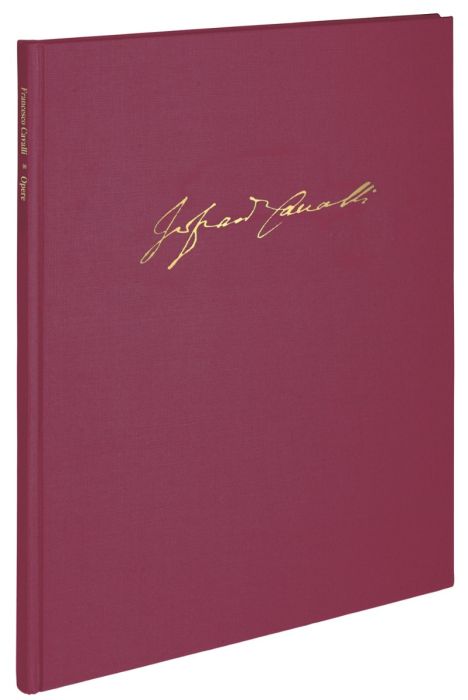
Veremonda, l'amazzone di Aragona (Full Score, hardback)
Cavalli, Francesco
Cavalli Veremonda, l'amazzone di Aragona (Full Score, hardback)
Francesco Cavalli’s “Veremonda, l’amazzone di Aragona” (Venice, 1652) is one of the composer’s most strikingly original and provocative operas. As one of the few early modern operas to engage so explicitly with the Christian-Muslim conflict, it underscores the complex relationship between the Ottoman Empire and the Venetian Republic—and notions about race and religion— that were central to life in the Mediterranean during this era. “Veremonda” is also the only opera by Cavalli for which we do not have an exact date or place of the first performance, although it was likely premiered in Venice in January of 1652. Two documented performances in Naples in December of that year led scholars to (mistakenly) assume that the opera premiered there. Drawing on a detailed study of the manuscript and extant librettos, this edition corrects that misconception, offers the definitive study of Cavalli’s compositional process, and introduces opera enthusiasts and professional musicians to one of the composer’s finest scores.
Inspired in part by the Spanish-Christian expansion on the Iberian Peninsula under Ferdinand and Isabella in 1492, the opera’s plot—and a substantial amount of its poetry—was taken directly from Giacinto Cicognini’s “Celio” (Florence 1646) and revised by the esteemed poet Giulio Strozzi, who infused the earlier libretto with the irony, humor, and gender ambiguity so typical of Venetian public opera. “Veremonda” centers on the conflict between the Spaniards and the Ottomans on the island of Gibraltar, led by the Spanish Queen Veremonda and her band of Amazons, and culminating in the defeat of the Moorish Queen Zelemina. Meanwhile, Delio, commander of the Spanish army, is secretly involved with Zelemina and attempts—unsuccessfully—to seduce Veremonda as well. When the Spanish King Alfonso hears false rumors of his wife’s affair with Delio, he rushes to join Veremonda’s Amazons for a bloody surprise attack on the Ottomans during a celebratory festival in honor of Mohammed. Zelemina is captured, begs for mercy, and declares her desire to convert to Christianity in order to marry her beloved Delio. The joyous celebration is interrupted when Alfonso and Veremonda hear a cry that the victory is not secure, and all the characters rush to defend the city walls. This tentative conclusion offers a vivid and realistic portrayal of Venice’s ambivalent relationship with the Ottomans.
Although the single surviving manuscript for the opera is one of Cavalli’s messiest—replete with cross-outs and paste-overs (Cavalli’s illegible hand often correcting and even writing over the efforts of the scribe)—its multiple layers, representing different stages in the opera’s composition, provide invaluable evidence about the opera’s genesis. For instance, the changes made for the Naples production appear only in the topmost layer of the manuscript—we can even see an instance in which a potentially blasphemous bit of text, acceptable in Venice, was censored in Naples, thus proving unequivocally that the Venetian version predates the Neapolitan one. Moreover, this musical archaeology allows us to witness how geopolitical concerns and gender ideologies prompted Cavalli and his libretto collaborators to make fundamental changes to the poetry and music.
“Veremonda”, composed by Cavalli at the height of his creative powers, possesses an almost Shakespearean blend of pathos, humor, violence, and sensuality. A brilliant and expressive work, it provides audiences with unique insights into the complexities of racial and religious conflicts in early modern Europe, and their impact on the development of opera as a genre.
- Cavalli: Edition of selected works
- Performance material (BA08909-72) available for hire
- Format 33,0 x 26,0 cm
 Click here to view the PDF